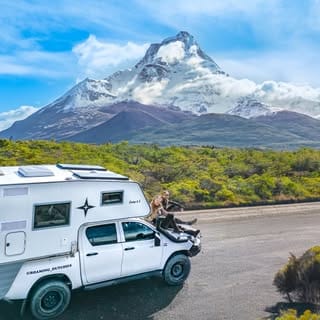
- Following 2K
- Followers 9.2K
- Engagement 5.7%
- Avg likes 431
- Avg comments 101
About TRAVEL | OVERLANDING | VANLIFE | PHOTOGRAPHY
TRAVEL | OVERLANDING | VANLIFE | PHOTOGRAPHY (@roaming_dutchies) is a Local & travel website creator on Instagram, also filed under Travel Influencers. The account has 9,159 followers and 289 published posts. Recent posts average 431 likes and 101 comments, an engagement rate of 5.7%.
TRAVEL | OVERLANDING | VANLIFE | PHOTOGRAPHY belongs to the nano tier, the band usually drawn between 1,000 and 10,000 followers. TRAVEL | OVERLANDING | VANLIFE | PHOTOGRAPHY follows 1,985 accounts, so the audience is roughly 4.6 times the size of the list followed. TRAVEL | OVERLANDING | VANLIFE | PHOTOGRAPHY is set up as an Instagram business account. Flinque files TRAVEL | OVERLANDING | VANLIFE | PHOTOGRAPHY under Local & travel website, with Travel Influencers as a secondary category.
The Instagram bio for TRAVEL | OVERLANDING | VANLIFE | PHOTOGRAPHY runs to 13 words across 2 lines. Emoji sit alongside the words. The latest activity Flinque has on record for TRAVEL | OVERLANDING | VANLIFE | PHOTOGRAPHY dates from July 2024.
Story Highlights
Unlocking shows the title and cover image of every story highlight this creator keeps pinned to the profile.
289 Posts
Of the 10 most recent posts shown for TRAVEL | OVERLANDING | VANLIFE | PHOTOGRAPHY, 7 are carousels and 3 are videos. That mix leans toward carousels. 289 published posts give TRAVEL | OVERLANDING | VANLIFE | PHOTOGRAPHY a moderate archive on Instagram. Against the audience, that is roughly 32 followers for each post published. TRAVEL | OVERLANDING | VANLIFE | PHOTOGRAPHY also keeps 38 story highlights on the profile. All 10 carry captions, averaging 257 words each. The captions are written mainly in English. Words that recur across them include people, wildlife, america, it’s and were. The captions tag #visitcolombia, #overlanding, #colombiatravel, #overlandcolombia and #visitecuador.
We climbed La Piedra (El Peñón de Guatapé) — a giant granite monolith that has stood here for around 70 million years, shaped by erosion while everything around it wore away. Long before it became a tourist highlight, the indigenous Tahamí people considered it sacred and called it mojarra.
The view from the top is surreal: turquoise waters dotted with green islands. What looks like a natural lake is actually the result of a 1970s hydroelectric project, when valleys were flooded to generate power. Entire towns were relocated, and the scattered islands you see today are the tops of once-inhabited hills. The dam still produces electricity for Colombia today.
The rock itself towers 200+ meters above the ground, and the climb takes you up a steep staircase of about 700 steps — totally worth it for the panorama at the top.
For us, this region was one of the highlights of the country. Endless green hills rolling in every direction, a pleasantly cool climate thanks to the altitude (2,135 m). The colorful town of Guatapé, with its brightly painted zócalos on the houses telling stories of local life, was a nice bonus. Be sure to combine it with a visit to Medellín, one of our favorite cities in Colombia.
📍El Peñón de Guatapé
💸Entrance: €5,50, cash only
📌Save this post for your Colombia visit!
Disclaimer: we photoshopped the first photo to remove the touristy buildings… because sometimes reality needs a little touch-up to match our daydreams.
#Guatapé #elpeñón #lapiedradelpeñol #Guatape #visitcolombia
Yes: this is literally its official name. And it’s not just a quirky title. This bird has one of the oddest, most fascinating looks of any bird in South America. Every angle makes you wonder: what shape is that head? Where is its beak?
Its loud, raspy calls are impossible to forget. Fun fact: the Cock-of-the-Rock is the national bird of Peru. Even though we spent weeks in the Amazon, we only spotted one during our hike to Machu Picchu.
The best place in the world to see them in the wild is actually in Colombia. Near Jardín, a low-key bird reserve hosts a so-called Lek: which is a kind of natural “dance floor” where males gather to show off for females.
They bow, flap, shout, and flaunt their fiery plumage, while females watch and choose their favorite. Fun fact: only the males have bright red-orange plumage; the females are camouflaged in brown.
These birds live in humid, rocky forests in the Andes, often near streams and waterfalls. In Jardin, you can see dozens of them performing every day—a rare chance to watch these usually shy birds up close.
If someone told us 2 years ago we’d drive six hours out of our way for a bird, we’d have called them crazy and laughed in their face!😆 But here we were; and it was definitely worth it.
You can’t go to Colombia and miss this one—it’s weird, wild, and wonderful all at once.
📍Reserva Natural Jardín de Rocas
💸Entrance fee: €3,25
💥Scroll to the last photo to see its beak!
📌Save this post for your Colombia visit!
✅Follow us for more wildlife & travel content
——————
#colombiawildlife #birdsofcolombia #birdsofinstagram
#jardin #Jardín
The Cocora Valley in Colombia is one of those places that leaves you in awe. Towering above the hills are the Quindío wax palms—the tallest palm trees in the world. Colombia’s national tree since 1985, some grow over 60 meters high and can live for nearly 200 years.
But their striking solitude hides a sad truth. This valley was once dense forest, but after the wax palm became protected, all the other trees were logged, leaving only the palms behind. So this stunning landscape—beautiful as it may seem—is in fact the result of massive deforestation.
The adult trees still stand tall, but without a forest, the young palms struggle to survive. Their seeds need shade and cover to grow—otherwise they dry out, get eaten, or trampled.
That’s why some scientists call these wax palms “living corpses”: tall and majestic, but with little chance of new generations to grow, without their forest home.
Still, there’s hope. Across Colombia there are projects working on conservation efforts to give this species a future. We actually saw many recently planted young palms. What’s missing, however, is clear information in the valley itself: tourists are not being informed that the iconic landscape is the result of deforestation, or what conservation work is being done.
Let’s hope nature will be protected, awareness will grow, and conservation efforts will succeed—so the Cocora Valley can be enjoyed not only today, but for generations to come.
——————
#cocoravalley #visitcolombia #colombiatravel #overlandcolombia #southamericatravel
One thing people always ask when we talk about our overlanding adventure in South America. Truth is, some days you roam without a care in the world… and other days, reality taps you on the shoulder.
Entering Colombia gave us one of those taps. Before crossing the border, we’d heard the South could be risky: the army had advised tourists to avoid certain regions because of guerrilla presence. Protests and road blockades had led to empty supermarkets, fuel shortages, and tourists stuck for up to two weeks. On top of that, we’d heard many first-hand stories of theft, and even armed robberies in broad daylight targeting wildcamping overlanders.
We don’t scare easily, but we do believe in being smart. Our first days in Colombia looked like this: drive, sleep, repeat; until we reached the safer Ibagué region.
The only stop before this region (and our first sightseeing stop of the country) was the Tatacoa Desert. Beautiful, scorching hot (45°C/113°F), and with zero suitable camp spots, so we hit the road again.
Besides seeing military parading the streets, our own experiences were positive, and the locals were welcoming.
For us, overlanding safety is having a peace of mind. It’s more about common sense than fear. Here’s how we roll:
* No driving in the dark
* Doors locked while driving
* In risky regions: stick to the main roads
* No wild camping in border regions
* Keep valuables out of sight
* Do research; ask in the overlanding community, check authorities info, consult locals, and check iOverlander’s alerts.
* Remember: It’s about an area, It’s never a whole country!🧡
This is our little recipe for peace of mind — not a rulebook for everyone.
💥We are curious:
Have you ever felt unsafe during travel?
What are your go-to safety rules when traveling?
💬Comment below!
——————
#tatacoadesert #desiertodelatatacoa #visitcolombia #colombiatravel #overlandcolombia
The most common question we get is about costs. So, how much does this lifestyle actually cost?
It’s time to break down the REAL expenses from our 7 weeks of overlanding in Ecuador.
The breakdown (per person, per month): • Food & Beverage: €231,34 of which:
· Groceries: € 148,62
· Eating Out € 82,72
•Transport: € 52,98 of which:
· Fuel & toll: € 52,44
· Public/Taxi: € 0,54
• Activities & entrance: € 51,43
• Supplies: € 52,76 of which:
· DIY, camping, pharmacy: € 29,69
· Souvenirs & shopping: € 23,06
• Accommodation: € 13,14
• Mobile phone € 11,13
Grand total:
* € 412,76 pp per month
* € 13,76 pp per day Our grand total for 7 weeks in Ecuador; we spent € 1320,84 for two people.
Fun facts: •Fuel usually eats up around 60% of our travel budget, but Ecuador was a nice exception. Diesel here was the cheapest we’ve seen, and the distances are short, so our tank barely felt it.
•Eating out was a bargain too; one time we even had dinner for 2 for only €10! •We also worked on assignments in jungle resorts in Mindo, where accommodation and food was provided; significantly reducing our total expenses.
*Excluding our 3 week trip to the Galapagos islands.
💬So, what do you think? Was it more or less than you expected?
💬Was this helpful to you or do you miss something? Let us know in the comments!
✅Follow us for more insights on REAL travel expenses
—————
#visitecuador #travelbudget #travelcosts #ecuadortravel #overlandlifestyle
Indeed, sometimes we are, but relying on luck alone is the biggest mistake you can make.
Here are the best practices WE use to increase our chances of great wildlife shots📸:
• Do research. Know the best location and timing for your subject. For humpback whales, we went in the right season to the right place: Puerto López, Ecuador.
• Do more research. Compare options and choose wisely. We found out around 95% of whale-watching tours give you only 30–40 minutes with the whales. We skipped the standard tours and joined a researcher’s boat: six hours with multiple humpbacks, including a mother, calf, and male escort; all while supporting marine microplastics research🙏
• Weather. Check the forecast and book last minute. Less cloud cover means more light and sharper shots.
• Lens. We used a 200–600 mm telephoto lens which is perfect for distant subjects like whales.
• Settings: ~ Shutter speed: Most important. On a wobbly boat with breaching whales: 1/2500 s. With other wildlife we rarely go under 1/1000s ~ Aperture: The widest possible aperture (low f-number) to allow more light in. ~ ISO: Keep it as low as possible. Up to 600 on bright days; we try to stay under 1600 on cloudy days. ~ High+ drive mode. Perfect for unpredictable wildlife behavior.
~ Subject/animal recognition on
~ Auto focus on tracking
~ Steady shot on
• Extra gear: A lens hood for water splashes, Fast, high-capacity SD cards (plus backups), 3 extra batteries, lens wipes, A waterproof bag
🐋Always Respect wildlife. Keep a safe distance, never touch or feed!
This is what works for us, shooting with the Sony Alpha 7R V, but settings can vary depending on the situation and camera.
In the end, good wildlife photography is part patience, part preparation… and a little bit of luck.
💥We put a lot of effort into writing this for you, so we’d love to hear if you found these insights helpful!
💬Missing something or have a question?
Drop it in the comments!
After 571 days, or 1 year and 7 months exploring the southern hemisphere, we finally stepped back into the northern half of the planet🌎
And where better than Quito, Ecuador, home to the famous “Middle of the World” monument?
See how Louise is already standing in the Northern hemisphere, while Doeke is still in the Southern hemisphere; the yellow ‘E’ equator line dividing us.
Here’s a fun twist: that monument isn’t exactly on the true 0.0° latitude line. Built in the 1930s by the French Geodesic Mission, it marked the equator as best they could back then. But modern GPS shows the real equator is a few hundred meters away at the Intiñan Solar Museum; where we truly stood ON the line.
Why is the equator so special? The sun passes directly overhead here twice a year, meaning no shadow at noon on those days.
Plus, the equator has no real seasons—days and nights are almost exactly 12 hours all year long.
Gravity’s slightly weaker too, because Earth bulges at the equator, so you technically weigh a tiny bit less.
Fun fact: ‘Ecuador’ means ‘equator’ in Spanish—a name that honors the country’s unique spot right on Earth’s center and its important role in early scientific exploration.
Crossing this invisible line feels huge. Who knows when we’ll ever be in the Southern hemisphere again?
Celebrating this milestone makes us feel so grateful for the incredible journey we’re on. This invisible line reminds us how small we are, yet how deeply connected in this wild, spinning world.
💬QUESTION: The equator crosses 12 other countries on our globe. Can you name any of them?
Comment below!
——————
#equator #quito #mitaddelmundo #visitecuador #ecuadortravel
From pink and vibrant yellow lagoons to surreal landscapes, you’ll find black and white sands twisted into remarkable shapes—waves, stripes, boomerangs—that seem almost otherworldly.
Imagine vast stretches of solitude, with no people, no animals, just a shifting landscape that keeps you guessing as it changes with every mile.
Surprisingly, this isn’t some alien world—it’s Paracas National Reserve. For just $4.50 a day you can explore it all, or, if you’re really feeling wild, go all in with a 30-day pass for $40!
Staying overnight is free, and you’ll not see another soul around. Some areas don’t have defined roads; you just follow old tire tracks or roam freely wherever your wheels take you—just remember to tread lightly.
Save this for an ultimate roadtrip on Peru’s Coast!
✅Follow us for more overlanding content
—————
We are Doeke and Louise from. We quit our jobs and travel in our offroad camper through South America and Central America. Follow along for adventures, remote places, wildlife, nature, overlanding and travel tips.
#perutravel #peruphotography #overlanding #toyotaoverlanders #truckcamper
Entering our 7th week of overlanding in the Amazon rainforest, this time exploring the Peruvian side.
What an expedition it’s been! We’ve crossed 16 rivers, 48 bridges, gotten stuck, rebuilt several collapsed bridges, had a monkey on our roof, encountered incredible wildlife, and witnessed magical sunsets from our wild camping spots.
Challenges were plentiful: scarce groceries, limited fresh water, no cellphone connection, and being stung by a swarm of mosquitoes—even on our eyelids!
It was epic, it was tough, and it was everything in between. This journey has truly been an overlander’s dream.
💬Comment What’s your dream holiday?
✅Follow for more travel content
—————
We are Doeke and Louise, the, an adventurous travel couple from the Netherlands. We quit our jobs and travel in our offroad camper through South America and Central America. Follow along for remote places, nature, wildlife, overlanding and travel tips.
#overlanding #offroad #overlandvehicle #roadtripping #overlandperu
People often ask us about our experiences: what is like, what have we done, where have we been? Well, have a look at 170 photo’s from our journey, flashing for you in the next 30 seconds. It offers just a small glimpse of our adventures📸
You know what is interesting? Narrowing down our top 25 photos from each country was a really DIFFICULT challenge. Disagreements on which photo’s should be included, may or may not have occurred😆 We both unanimously agree that this has been the most incredible chapter in our lives thus far.
Onto the next adventure 📸🚐🌎
‼️Let us know in the comments which picture stuck with you the most!⬇️
—————
We are Doeke and Louise from. We quit our jobs and travel in our offroad camper through South America and Central America. We are photographers and videographers with a big passion for wildcamping. Follow along for adventures, remote places, wildlife, nature, overlanding and travel tips.
Overlanding adventures | wildcamping in nature | offroad vanlife with pick-up camper | travel lifestyle | freedom | adventure couple | photography & videography | South America
#overlanding #truckcamper #pickupcamper #vanlife #outdoorlife
TRAVEL | OVERLANDING | VANLIFE | PHOTOGRAPHY's engagement
TRAVEL | OVERLANDING | VANLIFE | PHOTOGRAPHY's engagement rate on Instagram is 5.7%, between 3% and 6%, or 3 to 6 likes and comments per 100 followers. On a typical post that comes to about 1 like or comment for every 18 followers. Comments stay close to likes on TRAVEL | OVERLANDING | VANLIFE | PHOTOGRAPHY's posts, at 431 likes and 101 comments on average, about 4.3 likes per comment.
Engagement rate
5.7%
- Avg likes
- 431
- Avg comments
- 101
- Interactions : followers
- 1 : 18
Lookalike Creators
A free account lists creators whose audiences behave like this one, ready to shortlist and compare side by side.
Age & Gender
Unlocking shows how this audience splits across age bands and gender, charted from follower data.
Audience Location
Unlocking reveals the countries and cities where the most active followers of this account are concentrated.
Primary Language
Unlocking shows the languages this audience uses most in comments, interactions and the content it consumes.
Audience Interests
Unlocking lists the topics and categories this audience follows and engages with most often across the platform.
Authenticity
Unlocking scores how genuine the audience is, flagging fake, inactive or bot followers found in engagement patterns.
Audience Quality Score
Unlocking gives one overall audience quality score combining authenticity, engagement, follower activity and audience relevance.
Brand Affinity
Unlocking names the brands this audience already follows, mentions or engages with across social platforms.
Content Strategy
Unlocking breaks down the content pillars, tone and visual style this creator uses, and which formats perform best.
Commercial Insights
Unlocking shows collaboration types, an estimated pricing tier and a brand safety risk read for sponsored campaigns.
Industry Fit
Unlocking rates how well this creator and audience align with specific industry verticals and brand categories.
Research TRAVEL | OVERLANDING | VANLIFE | PHOTOGRAPHY further
TRAVEL | OVERLANDING | VANLIFE | PHOTOGRAPHY is listed in 1 Flinque ranking of Instagram creators, and the free tools beside it measure the same figures for any public account.
Frequently asked questions
These answers about TRAVEL | OVERLANDING | VANLIFE | PHOTOGRAPHY are generated from the Instagram profile data Flinque holds for the account.
Who is TRAVEL | OVERLANDING | VANLIFE | PHOTOGRAPHY?
TRAVEL | OVERLANDING | VANLIFE | PHOTOGRAPHY (@roaming_dutchies) is a Local & travel website creator on Instagram, also filed under Travel Influencers. TRAVEL | OVERLANDING | VANLIFE | PHOTOGRAPHY is set up as an Instagram business account. The Instagram bio for TRAVEL | OVERLANDING | VANLIFE | PHOTOGRAPHY runs to 13 words across 2 lines.
How many followers does TRAVEL | OVERLANDING | VANLIFE | PHOTOGRAPHY have?
TRAVEL | OVERLANDING | VANLIFE | PHOTOGRAPHY has 9,159 followers on Instagram (9.2K). TRAVEL | OVERLANDING | VANLIFE | PHOTOGRAPHY follows 1,985 accounts, so the audience is roughly 4.6 times the size of the list followed. 289 published posts give TRAVEL | OVERLANDING | VANLIFE | PHOTOGRAPHY a moderate archive on Instagram.
What is TRAVEL | OVERLANDING | VANLIFE | PHOTOGRAPHY's engagement rate?
TRAVEL | OVERLANDING | VANLIFE | PHOTOGRAPHY's engagement rate on Instagram is 5.7%, between 3% and 6%, or 3 to 6 likes and comments per 100 followers. On a typical post that comes to about 1 like or comment for every 18 followers. Comments stay close to likes on TRAVEL | OVERLANDING | VANLIFE | PHOTOGRAPHY's posts, at 431 likes and 101 comments on average, about 4.3 likes per comment.
What does TRAVEL | OVERLANDING | VANLIFE | PHOTOGRAPHY post about on Instagram?
Flinque files TRAVEL | OVERLANDING | VANLIFE | PHOTOGRAPHY under Local & travel website, with Travel Influencers as a secondary category. Of the 10 most recent posts shown for TRAVEL | OVERLANDING | VANLIFE | PHOTOGRAPHY, 7 are carousels and 3 are videos. The 10 recent Instagram captions Flinque holds for TRAVEL | OVERLANDING | VANLIFE | PHOTOGRAPHY repeatedly use the words people, wildlife, america, it’s and were. TRAVEL | OVERLANDING | VANLIFE | PHOTOGRAPHY's captions carry hashtags such as #visitcolombia, #overlanding and #colombiatravel. TRAVEL | OVERLANDING | VANLIFE | PHOTOGRAPHY writes those captions mainly in English. TRAVEL | OVERLANDING | VANLIFE | PHOTOGRAPHY keeps 38 story highlights, which open with a free Flinque account.
How do I contact TRAVEL | OVERLANDING | VANLIFE | PHOTOGRAPHY for a collaboration?
TRAVEL | OVERLANDING | VANLIFE | PHOTOGRAPHY's contact details are not published on Flinque's public profile. The Instagram bio links to 1 external site, and a free Flinque account opens that link. The account is registered as an Instagram business account. Brands with a free Flinque account can shortlist TRAVEL | OVERLANDING | VANLIFE | PHOTOGRAPHY and use Flinque's outreach tools wherever a contact route is on file.
Links
TRAVEL | OVERLANDING | VANLIFE | PHOTOGRAPHY's own Instagram profile is the one outbound link Flinque publishes for the account, and the bio link opens after signing up.
Public profile data sourced from Instagram. Flinque is not affiliated with TRAVEL | OVERLANDING | VANLIFE | PHOTOGRAPHY.