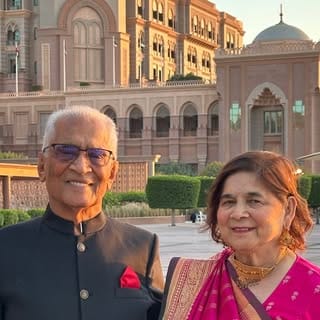
- Following 20
- Followers 10.4K
- Engagement 3.74%
- Avg likes 418
- Avg comments 7
About Kailash & Vimla Bafna Adventures
Kailash & Vimla Bafna Adventures (@kvbadventures) is a Personal blog creator on Instagram, also filed under Travel. The account has 10,400 followers and 146 published posts. Recent posts average 418 likes and 7 comments, an engagement rate of 3.74%.
With 10.4K followers, Kailash & Vimla Bafna Adventures is a micro creator by the common 10,000 to 100,000 definition. Set against 20 accounts followed, the audience works out to about 520 followers per account Kailash & Vimla Bafna Adventures follows. Kailash & Vimla Bafna Adventures uses an Instagram professional account. Flinque files Kailash & Vimla Bafna Adventures under Personal blog, with Travel as a secondary category.
Kailash & Vimla Bafna Adventures writes a longer Instagram bio of 30 words. The latest activity Flinque has on record for Kailash & Vimla Bafna Adventures dates from January 2026.
Story Highlights
Unlocking shows the title and cover image of every story highlight this creator keeps pinned to the profile.
146 Posts
All 10 recent posts Flinque holds for Kailash & Vimla Bafna Adventures are carousels. 146 published posts give Kailash & Vimla Bafna Adventures a moderate archive on Instagram. Against the audience, that is roughly 71 followers for each post published. Kailash & Vimla Bafna Adventures also keeps 6 story highlights on the profile. All 10 carry captions, averaging 385 words each. The captions are written mainly in English. Words that recur across them include were, india, since, left and family.
In October 2024, Vimla developed severe back pain which was extremely debilitating. As such, in 2025 we delayed visiting India till mid-March and stayed there only 2 weeks.
On March 31, we flew to Abu Dhabi for the week-long festivities to celebrate the wedding of our grandson, Shreyans. He married Sonya Vijayvargiya at the Emirates Palace in the grandest manner that we have ever witnessed in our lifetime.
A few hours before returning home, Shivani, our granddaughter, and Shyam shared the good news that she was expecting a baby. We were truly elated to hear this news and started dreaming of the possibility of seeing our Great Grandchild.
In the first week of May, Vimla had major back surgery to alleviate her problems of the last 7 months. With continuing healing, she has improved tremendously and is able to live life the way she wants to.
In July, our entire family went to New York to attend a Kathak dance performance in the famed Carnegie Hall. Seeing our daughter, Shivika Jain, perform on that stage was truly a very proud moment for us.
At the end of August, we went to Ann Arbor to attend Shivani’s Godh Bharai (baby shower) celebrated in true Indian tradition. Our entire family was there for 3 days making this event very memorable.
Just a week later, the family assembled again in Indianapolis to see the Rang Manch Pranam of our daughter, Shivika. She had been learning Kathak dance for the past 8 years, and this performance was for her ‘graduation’. She gave a solo 2-hour Kathak performance on the stage and, despite her age, she completed the entire 7-dance show without a glitch.
On the day of Diwali we got the excellent news that we had become Great Grandparents. Our granddaughter, Shivani, gave birth to a beautiful son, Krish. Since his home coming on the 22nd, he has brightened the lives of the entire household of four generations.
Finally, Shamik and Shalini arranged a year-end get together for our entire family to celebrate the New Year. They rented a large condominium, and we all shifted there for 2 days and spent some real quality time together.
Kailash, being the most educated in the family, was asked to design a new product currently being imported by all the State Electricity Boards. Taking on this challenge, he had a new design ready within a few months. Unfortunately, he met a lot of resistance in its approval by several Government departments because their employees would lose the free trips they made abroad for this product. Their final approval came in early 1977 (a whole year later). The roadblocks and unnecessary delays that Kailash had faced at various levels of Government completely frustrated him. This was even more painful since he had spent 10 years in the U.S. where things moved so smoothly.
During this 1 ½ years, Kailash generally spent weekdays in Delhi, Lucknow, or other cities, returning home on weekends. Unfortunately, due to power load shedding, the Nagpur facilities were closed on Thursdays. As a result, Kailash worked 7 days a week on many occasions and could not give much time to the family who was also trying to get adjusted in India. When Kailash asked his brothers for him to take on additional responsibilities in the family business, they were reluctant to share or give up control of their business. This, along with the frustrations and stresses of work and family life, was too much for him and he decided to return to the U.S.
When Kailash discussed the idea with Vimla about returning to the U.S., she said to first procure a job before we can consider returning. He then contacted his professors at Purdue University and his colleagues at Geogia Tech. With excellent recommendations from these faculty at two top Universities, Kailash received a job offer, without an interview, as an Associate Professor at the University of Wisconsin in Platteville. He accepted this offer.
The rest of my Caption is continued in the Comments.
During 10 years in the U.S., Kailash completed M.S. and Ph.D. degrees and taught at Georgia Institute of Technology. We then decided to return to India permanently to join our extensive family manufacturing businesses. Since tourism was almost non-existent, we decided to drive from Atlanta in U.S. to Nagpur in India seeing countries in Europe and Asia. In preparation, we purchased a new Fiat car, applied for an import license, and received it from the Govt. of India.
Our daughter, Shivika, was under a year old and taking her on this journey would be very strenuous for us and for her. As such, we sent her to India with our friend so that Kailash’s oldest brother and his wife could take care of her for a few months. After obtaining the necessary visas (Kailash had an Indian passport and Vimla and our son, Shamik, had U.S. passports), we wound up everything and left by car for New York on Aug. 3, 1975, driving all night to get there by early next morning. We put our car on a ship bound for Europe and flew into Edinburgh and then London.
We flew into Antwerp on Aug. 19, picked up our car from the port, and started our journey to India with lots of sightseeing and adventures along the way. We drove through 18 countries in Europe, the Middle east, Afghanistan, Pakistan to India, reaching Delhi on Nov. 2, 1975.
During this journey, we drove 12,682 miles and used 629 gallons of gasoline costing us U.S. $686. Fuel was the most expensive in England and cheapest in Iran. To learn about local culture, we decided to stay with local families. We spent 42 nights at the homes of the families of Kailash’s students at Georgia Tech. We also spent 48 nights in hotels. We maintained a daily log of expenses, distance traveled and gasoline fill-ups. Upon request by some of our readers, we have also included the photos of the family taken in 1975 and, 50 years later, in 2025.
In our next post, we will describe our return to the U.S.
We had deposited our car in the Custom House in Delhi on Nov. 7. On Monday, Vimla and I went to the Custom House to find out how much Import Duty we had to pay. Since our car, Fiat Mirafiori 131, was brand new on the market, the Customs House did not have any prices in their records. It took us four days, and we spent several hours each day with them before we could come up with a mutually acceptable value for the car. Finally, on Friday Nov. 14, we paid the duty at 160% of that value and they released our car.
On Nov. 19, we left for Jodhpur, Rajasthan to attend the wedding of Kailash’s nephew, Mahendra, on Nov. 25. There we saw our daughter, Shivika, then 14 months old, running around and dancing. She did not recognize us as her parents and, despite everyone repeatedly telling her that we were her Mummy and Daddy, called us Kaka and Chaachi. It was, of course, heartbreaking but we understood.
After a few days, we traveled by train to Jaipur to attend my younger brother, Narendra’s wedding on Dec. 11. This event was celebrated with great pomp and show and almost our entire family was present. I insisted on a family photo being taken.
We returned to Delhi on Dec. 16 and our first order of priority was to have the window glass that was broken on our way to Delhi repaired. Since an original glass was not available, the body shop fabricated one from plexiglass. We left for Agra on Dec. 20 morning. After touring the Taj Mahal, we continued, passing Dholpur and Morena. Since the dacoits were very active in this Chambal region, we were warned to cross this area during daylight. We reached Gwalior in the evening and checked into a hotel. We left early on Sunday Dec. 21 and drove all day, finally reaching our destination, Nagpur, in the evening. We parked the car in the garage and were happy that our road trip was now complete. Surprisingly, the next morning, we found a flat tire on our car, the first on the entire trip.
Early morning on Nov. 2, he came to the hotel and took us along with our 3 ‘gatharis’ and a small suitcase to the train station and sat us in a First-Class compartment in Amritsar Mail. In Delhi, our Agent, Virendra Kumarji received us and was shocked to see us traveling in first-class with 3 “Gatharis.” He told us not to talk with anyone and just walk out since a National Emergency was in force.
Virendraji took us to his house in south Delhi where we had lunch. He loaned Kailash one of his cars so we could drive to Rajouri Gardens where Vimla’s parents lived. They were aware of our journey but were surprised to suddenly see us in person. We left Atlanta on Aug. 3rd and reached India on Nov. 2nd, a day before Diwali. We were all incredibly happy to have reached our destination after safely completing our extremely adventurous road journey.
After 3 days, with the help of Vimla’s father, a senior Central Government employee, we got a letter from the Customs Department to allow us to pay the Import Duty in Delhi. Kailash returned with this to Amritsar by train and, after paying Rs.1,500 as Escort Fee, they released the car but had one of their employees accompany him to Delhi.
They both left Amritsar early in the evening and took the highway to Delhi. After a brief stop for dinner, they continued their journey towards Delhi on this 2-lane highway. Suddenly, a truck travelling to Amritsar hit the passenger side mirror which turned and shattered a window glass. Since it was dark, for safety reasons, we continued with frigid air entering our car. We reached home in Rajouri Gardens at about 1 am, and the escort slept in the car overnight. The next morning, Kailash drove the car and deposited it in the Custom House in New Delhi. Although we had reached our destination, we still needed to get our car back.
Once again, the Officer saw Vimla and Shamik’s U.S. Passports and everything looked normal. When he got to Kailash’s Indian Passport, his eyes almost popped out. He asked Kailash, “Did you really drive through Pakistan?” Kailash answered, “Yes, I was given a Transit Visa.” The Officer said, “Since the second Indo-Pak War ten years ago, you are the first Indian Passport holder to be given a Visa to drive through Pakistan.”
He took all three of us into a room and, with two other officers by his side, they asked a barrage of questions to know how we Indians were treated while in Pakistan. After about twenty minutes, they took us back to our car and their ‘friendly nature’ turned into a form of ‘hostility.’ Since we were moving to India, they asked for the authorization to import our car. We showed them the Import License for the car which we had obtained before leaving the U.S. With a Custom Officer accompanying us in our car, we drove to the Custom Houe in Amritsar. There they asked us to pay the ‘import duty.’ Kailash said that arrangements were already made for us to pay for it in New Delhi, but they did not budge from their demand.
From there, Kailash phoned a contact he had for someone in Amritsar. When that person heard that I was calling from the Custom House, he said, “I don’t know anyone there” and hung up. The Officer then accompanied us to a nearby hotel, had us unload all our belongings from the car into the hotel room, and drove the car back to the Custom House. Then they told us, “When the duty is paid in full, we will release your car.” Kailash took a rickshaw back to the hotel.
When the hotel manager heard of our plight, he felt sorry for us and arranged our lunch. After 5:00 pm Kailash again phoned the contact and, upon hearing his story, immediately came to the hotel and took us to his house. There we had dinner and developed a game plan for us to go to Delhi the next day.
We drove 15 miles to the Wagah Border and were excited that soon we would reach our home—India. The Immigration Officer asked us for our Passports. First, he looked at Vimla’s and Shamik’s Passports (U.S.A.). However, when he saw Kailash’s Passport (Indian), his facial expression changed. He stopped on the page having the Transit Visa which read, “Three days via Torkham – Peshawar – Lahore & Wagah & Attari to India.”
In a serious tone, the Officer said “You cannot exit from this check post. You should try and cross the border near Karachi.” When Kailash asked for the reason, he said, “Since the 1965 war with India, we have an unwritten rule which says that ‘Hindus and Sikhs cannot cross at Wagah Border.’” We told him that Kailash was given the visa specifying that he should exit at Wagah. The Officer responded, “The Visa is for your car to exit from here. Your wife and child can take the car and exit just now, but you cannot. If you want to exit from here, you must go back to Islamabad and get it specifically endorsed that you could exit from Wagah.”
We were now in a serious dilemma. Going back to Islamabad was not a possibility since Government Offices were only open for half a day on Saturdays. All three of us sat in our car discussing and pondering the situation. After about two hours, we suddenly got an idea. Kailash went to the Officer and asked him to repeat the rule to which he responded, “Hindus and Sikhs cannot cross at this check post.” Kailash told him that we were arguing uselessly because we are not Hindus nor Sikhs, but we are ‘Jains.’ The officer then took us to the Head of the Check Post, and we repeated the same story in front of him. Hearing everything and questioning us about Jainism, he told the Officer to let us sign in their Register, “By God I am a Jain” and let them go.
It took us about a half hour to complete the rest of the formalities and, finally, we were on our way to the Indian Check Post, Attari Road.
We continued traversing the hilly terrain through the historic Khyber Pass seeing drastic changes in the landscapes as we approached Peshawar. For hundreds of years, this route had been used for invasions of the Indian subcontinent starting with Alexander the Great, the Persians, and followed by Muslim Emperors. At the end of the Pass, the confined landscape finally gave way to large fertile and well irrigated fields.
After driving through the cities of Peshawar and Rawalpindi, we finally reached the city of Lahore by late evening. We had driven about 500 miles and were ready to rest for the night. As such, we pulled into a hotel to book a room. After completing the necessary paperwork, Kailash asked the hotel management where he should park his car. When they saw the license plate, they asked for our passports. Upon seeing Kailash’s Indian Passport, they said we don’t have a room. We went to another hotel and the same sequence of events took place. In this manner, we went to four other hotels and experienced the same frustration. It was now almost 10:30 pm.
We finally decided to go to the house of one of our Atlanta friends, Syed Nooruddin. His sister was married to a judge in Lahore. After asking for directions at multiple places, we slowly made progress, finally reaching there by almost midnight. When they answered the door and we told them who we were, they welcomed us into their home, and we spent talking about Mr. Nooruddin for almost two hours. Finally, we went to sleep around 2 am.
Since we did not have a map of Afghanistan, we asked the person at the front desk in the hotel about the road to Kabul. He told us “Just follow the paved road and it will pass Kandahar in the south and then turn north and continue to Kabul. The distance will be about 600 miles.” As we drove during the day, we passed through mostly hilly terrain, some irrigated lands in fertile river valleys having small farms, and large sections of hilly desert terrain without any vegetation. Occasionally we saw large patches of purple flowers and so we stopped on the roadside to allow Shamik to get down, stretch his legs, and admire these beautiful flowers.
As we passed through smaller towns on the way, along the roadside we saw clusters of buildings with domed roofs. These were used as truck stops and accommodated small local restaurants (equivalent to Dhabas in India) and shops selling some vegetables and locally made artifacts. Occasionally, we stopped on the highway to allow a heard of wild camels to cross the road. At one point, we even stopped to allow a family of nomads with their belongings strapped onto camels and donkeys to cross the road. They even had their dog accompanying them.
After driving for almost 12 hours, we finally reached the outskirts of the capital city of Kabul by about 8 pm. We were given a contact in Kabul by my family and decided to stay with them, a local Afghani family who spoke some Hindi and English. We telephoned them to get directions and reached their home half an hour later. It had been a long and tiring day, and we were glad to finally reach our destination.
Chalus Road is Iran’s most scenic road. This highway crosses the Alborz Mountains and connects Tehran to the Caspian Sea resort city of Chalus. It is about sixty miles long and we got stunning views of the mountain ranges, lush forests, rivers, and winding roads. We were asked to be careful while driving because many accidents take place on this road, and cars can easily fall hundreds of feet down into the ravines.
As we approached Chalus, the landscape became less “threatening” and the hills gradually faded away into flat lands surrounded by greenery. We drove to a point where we got a view of the deep blue waters of the Caspian Sea before returning to the highway heading towards Mashhad. After driving almost 600 miles, we reached the city early in the evening. We were tired and checked into a hotel for the night.
The next morning, after breakfast we drove to the Goharshad Mosque. We passed by a few roadside food stalls which resembled many stalls we had seen in India. Also, along the roadside we saw several friends holding their prayer beads (called tasbih) to recite prayers while remembering Allah, their God. During this process, they were also casually having their morning chat.
We reached the Mosque around 10 am, parked our car, and walked inside the gates into the compound. It was large and spread out quite a bit. It is a congregational mosque built almost 600 years ago. We were amazed by the sheer size and height of the dome and the arch built within an arch. The entire surface was covered with enamel tiles of different shades of blue, green, and yellow. The large doors were also very ornate with intricate designs. Touring the entire Mosque and seeing the architecture was very pleasing and reminded us of the high levels of human craftsmanship that existed. After lunch, we left Mashhad for our next destination, Afghanistan.
Kailash & Vimla Bafna Adventures's engagement
Kailash & Vimla Bafna Adventures's engagement rate on Instagram is 3.74%, between 3% and 6%, or 3 to 6 likes and comments per 100 followers. On a typical post that comes to about 1 like or comment for every 27 followers. Likes outnumber comments by roughly 60 to 1, with 418 likes and 7 comments on an average post, so most reactions are taps rather than replies.
Engagement rate
3.74%
- Avg likes
- 418
- Avg comments
- 7
- Interactions : followers
- 1 : 27
Lookalike Creators
A free account lists creators whose audiences behave like this one, ready to shortlist and compare side by side.
Age & Gender
Unlocking shows how this audience splits across age bands and gender, charted from follower data.
Audience Location
Unlocking reveals the countries and cities where the most active followers of this account are concentrated.
Primary Language
Unlocking shows the languages this audience uses most in comments, interactions and the content it consumes.
Audience Interests
Unlocking lists the topics and categories this audience follows and engages with most often across the platform.
Authenticity
Unlocking scores how genuine the audience is, flagging fake, inactive or bot followers found in engagement patterns.
Audience Quality Score
Unlocking gives one overall audience quality score combining authenticity, engagement, follower activity and audience relevance.
Brand Affinity
Unlocking names the brands this audience already follows, mentions or engages with across social platforms.
Content Strategy
Unlocking breaks down the content pillars, tone and visual style this creator uses, and which formats perform best.
Commercial Insights
Unlocking shows collaboration types, an estimated pricing tier and a brand safety risk read for sponsored campaigns.
Industry Fit
Unlocking rates how well this creator and audience align with specific industry verticals and brand categories.
Research Kailash & Vimla Bafna Adventures further
Flinque ranks Instagram creators in Personal blog and Travel, categories Kailash & Vimla Bafna Adventures is filed under, and its free tools measure the same figures for any public account.
Related rankings
Frequently asked questions
These answers about Kailash & Vimla Bafna Adventures are generated from the Instagram profile data Flinque holds for the account.
Who is Kailash & Vimla Bafna Adventures?
Kailash & Vimla Bafna Adventures (@kvbadventures) is a Personal blog creator on Instagram, also filed under Travel. Kailash & Vimla Bafna Adventures uses an Instagram professional account. Kailash & Vimla Bafna Adventures writes a longer Instagram bio of 30 words.
How many followers does Kailash & Vimla Bafna Adventures have?
Kailash & Vimla Bafna Adventures has 10,400 followers on Instagram (10.4K). Set against 20 accounts followed, the audience works out to about 520 followers per account Kailash & Vimla Bafna Adventures follows. 146 published posts give Kailash & Vimla Bafna Adventures a moderate archive on Instagram.
What is Kailash & Vimla Bafna Adventures's engagement rate?
Kailash & Vimla Bafna Adventures's engagement rate on Instagram is 3.74%, between 3% and 6%, or 3 to 6 likes and comments per 100 followers. On a typical post that comes to about 1 like or comment for every 27 followers. Likes outnumber comments by roughly 60 to 1, with 418 likes and 7 comments on an average post, so most reactions are taps rather than replies.
What does Kailash & Vimla Bafna Adventures post about on Instagram?
Flinque files Kailash & Vimla Bafna Adventures under Personal blog, with Travel as a secondary category. All 10 recent posts Flinque holds for Kailash & Vimla Bafna Adventures are carousels. The 10 recent Instagram captions Flinque holds for Kailash & Vimla Bafna Adventures repeatedly use the words were, india, since, left and family. Kailash & Vimla Bafna Adventures writes those captions mainly in English. Kailash & Vimla Bafna Adventures keeps 6 story highlights, which open with a free Flinque account.
How do I contact Kailash & Vimla Bafna Adventures for a collaboration?
Kailash & Vimla Bafna Adventures's contact details are not published on Flinque's public profile. Brands with a free Flinque account can shortlist Kailash & Vimla Bafna Adventures and use Flinque's outreach tools wherever a contact route is on file.
Links
Kailash & Vimla Bafna Adventures's own Instagram profile is the one outbound link Flinque publishes for the account.
Public profile data sourced from Instagram. Flinque is not affiliated with Kailash & Vimla Bafna Adventures.