- Following 568
- Followers 8.8K
- Engagement 1.71%
- Avg likes 141
- Avg comments 2
About Japanese Antique Screens and Scrolls
Japanese Antique Screens and Scrolls (@japanese.screens) is an Antique Store creator on Instagram, also filed under eCommerce/DTC. The account has 8,805 followers and 177 published posts. Recent posts average 141 likes and 2 comments, an engagement rate of 1.71%.
Japanese Antique Screens and Scrolls belongs to the nano tier, the band usually drawn between 1,000 and 10,000 followers. Japanese Antique Screens and Scrolls follows 568 accounts, so the audience is roughly 16 times the size of the list followed. Japanese Antique Screens and Scrolls is set up as an Instagram business account. Flinque files Japanese Antique Screens and Scrolls under Antique Store, with eCommerce/DTC as a secondary category.
The Instagram bio for Japanese Antique Screens and Scrolls runs to 18 words across 3 lines. Emoji sit alongside the words. The latest activity Flinque has on record for Japanese Antique Screens and Scrolls dates from July 2024.
Story Highlights
Unlocking shows the title and cover image of every story highlight this creator keeps pinned to the profile.
177 Posts
Of the 10 most recent posts shown for Japanese Antique Screens and Scrolls, 9 are carousels and 1 is a single image. That mix leans toward carousels. 177 published posts give Japanese Antique Screens and Scrolls a moderate archive on Instagram. Against the audience, that is roughly 50 followers for each post published. Japanese Antique Screens and Scrolls also keeps 2 story highlights on the profile. All 10 carry captions, averaging 186 words each. The captions are written mainly in English. Words that recur across them include screen, period, size, japaneseantiques and byōbu. The captions tag #japaneseantiques, #japanesefoldingscreen, #asianart, #meijiperiod and #goldleaf.
Size: 370 × 172 cm (145¾ × 67¾ in) — each screen
Period: Meiji
SKU: 2218
An impressive pair of six-panel Japanese folding screens (byōbu) from the Meiji period, depicting a sweeping mountain landscape rendered in fine ink brushwork across a radiant gold-leaf (kinpaku) ground. Jagged peaks, mist-veiled valleys, pine-covered hillsides, and quiet waterways unfold across the panels, evoking the timeless serenity of the Japanese sansui (mountain-and-water) painting tradition. The warm luminosity of the gold ground lends the composition an air of quiet grandeur, balancing delicate detail with monumental scale.
Together, the pair forms a continuous panoramic vista — a striking statement piece for any interior, whether displayed side by side or independently.
✨ A monumental Meiji-period pair — rare in scale, exceptional in presence. DM us or visit the link in bio to inquire.
#JapaneseAntiques #MeijiPeriod #JapaneseFoldingScreen #GoldLeaf #AsianArt
Size: 370 × 172 cm (145¾ × 67¾ in) — each screen
Period: Meiji
SKU: 2217
An impressive pair of six-panel Japanese folding screens (byōbu) from the Meiji period, depicting a sweeping mountain landscape rendered in fine ink brushwork across a radiant gold-leaf (kinpaku) ground. Jagged peaks, mist-veiled valleys, pine-covered hillsides, and quiet waterways unfold across the panels, evoking the timeless serenity of the Japanese sansui (mountain-and-water) painting tradition. The warm luminosity of the gold ground lends the composition an air of quiet grandeur, balancing delicate detail with monumental scale.
Together, the pair forms a continuous panoramic vista — a striking statement piece for any interior, whether displayed side by side or independently.
✨ A monumental Meiji-period pair — rare in scale, exceptional in presence. DM us or visit the link in bio to inquire.
#JapaneseAntiques #MeijiPeriod #JapaneseFoldingScreen #GoldLeaf #AsianArt
Size: 147 × 106 cm (58 × 41¾ in)
Period: Edo
SKU: 2384
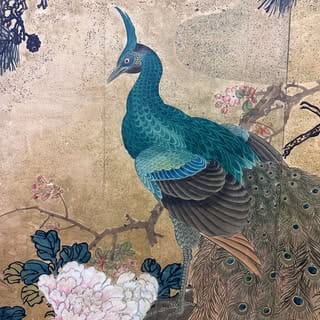
A magnificent two-panel Japanese folding screen (byōbu) from the Edo period, featuring a striking pair of peafowl (kujaku) perched together amid an abundant display of peonies (botan) in pure white and vivid crimson, set against a warm golden ground. The birds are rendered with extraordinary care — their iridescent green necks, elegant crested heads, and richly patterned tail feathers spread in full, eye-catching splendour across the lower panel.
Painted as a devoted pair rather than a solitary figure, the peafowl here carry a deepened symbolism: in Japanese art, the peafowl represents beauty, dignity, and good fortune, while a pair together speaks to harmony, companionship, and enduring partnership. Combined with the peony — long regarded as the king of flowers, symbolising prosperity and honour — this composition becomes a powerful expression of nobility and romantic devotion, making it an especially meaningful and auspicious subject.
✨ A radiant Edo-period celebration of beauty and partnership — a striking centrepiece for any collection. DM us or visit the link in bio to inquire.
#JapaneseAntiques #EdoPeriod #JapaneseFoldingScreen #Peacock #AsianArt
Period: late Edo, early 19th century
Size: 376 x 172 cm
SKU: 2222
This exquisite late Edo period Rinpa school screen showcases lush chrysanthemum branches in full bloom, flourishing within their natural setting. Painted with vibrant colors, the chrysanthemum blossoms are captured in exquisite detail, enveloping the scene with an aura of beauty and elegance.
The Rinpa school, a prominent Japanese art movement that thrived throughout the Edo period ), gained recognition for its bold hues, elaborate designs, and idealized depictions of nature. This screen beautifully exemplifies the Rinpa style, serving as a testament to the remarkable skill and artistic prowess of its creator.
Elevate your space with this unique screen – a captivating conversation starter and a prized collectible.
DM us to learn more!
#RinpaArt #JapaneseAntiques #JapaneseScreen #VintageJapanese #AntiqueScreens «
Size: 355 × 172 cm (139¾ × 67¾ in)
Period: Meiji
SKU: 2554
#JapaneseAntiques #MeijiPeriod #JapaneseFoldingScreen #SilverLeaf #AsianArt
Size: 140 × 140 cm (55 × 55 in
Period: Contemporary
SKU: AB22
A striking and entirely original two-panel Japanese folding screen (byōbu) created in a bold mixed media technique, seamlessly bridging the classical byōbu tradition with a distinctly contemporary artistic vision. The composition is divided between two contrasting worlds: on the left panel, a crocodile emerges from misty, ink-washed depths in monochrome — its powerful scaled body rendered with the fluid precision of traditional sumi-e brushwork. On the right, an abundant canopy of water lily pads fills the surface in rich tones of gold, amber, and bronze, punctuated by delicate white water lily blossoms floating serenely at the surface.
The most remarkable feature of this work is its use of translucent lacquer (urushi): applied to the crocodile’s scales and the centres of the lily pads, it creates a luminous, three-dimensional effect — catching the light and giving the surface an almost living quality. The result is a screen that rewards close looking, shifting between painting and sculptural object.
In Japanese art, the water lily — rising from dark, still water — carries associations of purity, quiet beauty, and the poetic transience of nature, a meaning that resonates powerfully alongside the primordial presence of the crocodile below.
✨ A rare contemporary byōbu for the collector who wants something truly unlike anything else. DM us or visit the link in bio to inquire.
#ContemporaryArt #JapaneseFoldingScreen #Byobu #AsianArt #JapaneseLacquer
Size: 376 × 173 cm (148 × 68 in)
Period: Meiji–Taisho
SKU: 2525
A profoundly atmospheric six-panel Japanese folding screen (byōbu) from the Meiji–Taisho period, executed in dramatic ink wash (sumi-e) on a softly luminous silver-grey ground. The sweeping composition depicts a classic sansui (mountain-and-water) landscape: jagged peaks rise through swirling mist, weeping willows and pine trees cling to rocky outcroppings along a vast, still lake, and a solitary pavilion emerges from the rocky shore on the right — a timeless refuge for a scholar or wandering poet. A tiny human figure can be discerned along the water’s edge, rendered in just a few brushstrokes, yet conveying an overwhelming sense of scale and solitude.
In the upper left panel, a calligraphic inscription adds a further layer of cultural depth — likely a poem or dedication in the classical tradition of East Asian literati painting, where word and image are considered inseparable.
The monochrome palette, the mist-veiled distances, and the philosophical stillness of this composition place it firmly in the tradition of Zen-influenced ink painting — art that invites contemplation rather than merely decoration.
✨ A monumental work of meditative beauty — rare in scale, extraordinary in atmosphere. DM us or visit the link in bio to inquire.
#JapaneseAntiques #MeijiPeriod #JapaneseFoldingScreen #SumiE #AsianArt
Size: 358 × 174 cm (141 × 68½ in)
Period: Edo
SKU: 2221
A breathtaking six-panel Japanese folding screen (byōbu) from the Edo period, depicting a joyful gathering of Japanese red-crowned cranes (tsuru) in a richly detailed landscape of pine trees, rolling hills, and a shimmering blue stream — all set against a luminous gold-dust (kindei) ground that glows with extraordinary warmth and brilliance.
The composition captures the cranes in a beautiful variety of poses: some wade serenely through the water, others preen and rest on the shore, while a graceful group descends from the golden sky above — wings outstretched, as if arriving at a place of eternal peace. The ancient pine tree anchoring the right panels, gnarled and sweeping, adds a sense of timeless permanence to the scene.
In Japanese culture, the crane is perhaps the most revered of all birds — a symbol of longevity, good fortune, fidelity, and peace. According to legend, a crane lives for a thousand years, and it is said that those who fold a thousand origami cranes (senbazuru) will be granted a wish. The crane is also a symbol of marital happiness, as cranes are believed to mate for life. A screen of this subject was traditionally considered one of the most auspicious gifts and interior adornments in Japanese aristocratic culture.
✨ One of the most celebrated motifs in Japanese art — rendered here with exceptional scale and brilliance. DM us or visit the link in bio to inquire.
#JapaneseAntiques #EdoPeriod #JapaneseFoldingScreen #Cranes #AsianArt
Size: 73 x 186 cm (73.2 × 28.7 in))
Period: Meiji - Taisho
SKU: 3501
A hauntingly beautiful Japanese nihonga painting in the bijinga tradition — depicting a young woman in a vivid cobalt-blue summer kimono (yukata), seated at the edge of a veranda (engawa) against the luminous geometry of paper screen doors (shōji), as darkness gathers on the water below. Titled "Summer Evening" and signed by Ishikawa Shozo with the artist's red seal, this work is a refined and deeply atmospheric example of the figurative painting tradition that flourished in Japan during the Meiji and Taisho periods.
The composition is a masterclass in restraint and suggestion. The woman's gaze is cast downward in a posture of quiet contemplation — her expression suspended between reverie and melancholy in the manner of the great bijinga masters. The brilliant ultramarine of her loosely worn yukata, its open neckline and casual drape suggesting the intimate informality of a private summer moment after bathing, is rendered with extraordinary chromatic intensity against the warm ivory of the shōji behind her, creating a contrast of near-electric visual power. Beside her, a folded towel with its striped border anchors the composition in the specific and the domestic — a detail of everyday life elevated, through the artist's eye, to the level of poetry.
The bijinga — painting of beautiful women — is among the most celebrated and demanding genres of Japanese pictorial art, with a lineage extending from the ukiyo-e masters of the Edo period through the great Meiji and Taisho painters. Ishikawa Shozo works here entirely within the nihonga tradition — mineral pigments on silk, the forms built through the most delicate layering of tone and color — while bringing to the subject a psychological subtlety and compositional sophistication that places this work among the finer examples of the genre.
#nihonga #bijinga
For over 25 years, our company has been a trusted name in Japanese antiques. Starting with Buddhist art, we have expanded our expertise to include all types of Asian antiques. For nearly two decades, we operated offline, welcoming customers in Japan and to our galleries in Thailand.
Now, we’re thrilled to bring our exquisite collection online! With over 150 stunning Japanese screens in our collection, we are dedicated to helping you find the perfect piece to complement your space.
Whether you’re an interior designer, a collector, or simply an admirer of Japanese art, we invite you to explore our collection and discover the elegance and beauty that each screen brings.
DM us for more details—we’re here to assist you in finding the perfect screen for your home or project.
#JapaneseAntiques #JapaneseScreen #JapaneseArt #AsianAntiques #InteriorDesign
Japanese Antique Screens and Scrolls's engagement
Japanese Antique Screens and Scrolls's engagement rate on Instagram is 1.71%, between 1% and 3%, or 1 to 3 likes and comments per 100 followers. On a typical post that comes to about 1 like or comment for every 58 followers. Likes outnumber comments by roughly 71 to 1, with 141 likes and 2 comments on an average post, so most reactions are taps rather than replies.
Engagement rate
1.71%
- Avg likes
- 141
- Avg comments
- 2
- Interactions : followers
- 1 : 58
Lookalike Creators
A free account lists creators whose audiences behave like this one, ready to shortlist and compare side by side.
Age & Gender
Unlocking shows how this audience splits across age bands and gender, charted from follower data.
Audience Location
Unlocking reveals the countries and cities where the most active followers of this account are concentrated.
Primary Language
Unlocking shows the languages this audience uses most in comments, interactions and the content it consumes.
Audience Interests
Unlocking lists the topics and categories this audience follows and engages with most often across the platform.
Authenticity
Unlocking scores how genuine the audience is, flagging fake, inactive or bot followers found in engagement patterns.
Audience Quality Score
Unlocking gives one overall audience quality score combining authenticity, engagement, follower activity and audience relevance.
Brand Affinity
Unlocking names the brands this audience already follows, mentions or engages with across social platforms.
Content Strategy
Unlocking breaks down the content pillars, tone and visual style this creator uses, and which formats perform best.
Commercial Insights
Unlocking shows collaboration types, an estimated pricing tier and a brand safety risk read for sponsored campaigns.
Industry Fit
Unlocking rates how well this creator and audience align with specific industry verticals and brand categories.
Research Japanese Antique Screens and Scrolls further
Flinque ranks Instagram creators in eCommerce/DTC, categories Japanese Antique Screens and Scrolls is filed under, and its free tools measure the same figures for any public account.
Related rankings
Frequently asked questions
These answers about Japanese Antique Screens and Scrolls are generated from the Instagram profile data Flinque holds for the account.
Who is Japanese Antique Screens and Scrolls?
Japanese Antique Screens and Scrolls (@japanese.screens) is an Antique Store creator on Instagram, also filed under eCommerce/DTC. Japanese Antique Screens and Scrolls is set up as an Instagram business account. The Instagram bio for Japanese Antique Screens and Scrolls runs to 18 words across 3 lines.
How many followers does Japanese Antique Screens and Scrolls have?
Japanese Antique Screens and Scrolls has 8,805 followers on Instagram (8.8K). Japanese Antique Screens and Scrolls follows 568 accounts, so the audience is roughly 16 times the size of the list followed. 177 published posts give Japanese Antique Screens and Scrolls a moderate archive on Instagram.
What is Japanese Antique Screens and Scrolls's engagement rate?
Japanese Antique Screens and Scrolls's engagement rate on Instagram is 1.71%, between 1% and 3%, or 1 to 3 likes and comments per 100 followers. On a typical post that comes to about 1 like or comment for every 58 followers. Likes outnumber comments by roughly 71 to 1, with 141 likes and 2 comments on an average post, so most reactions are taps rather than replies.
What does Japanese Antique Screens and Scrolls post about on Instagram?
Flinque files Japanese Antique Screens and Scrolls under Antique Store, with eCommerce/DTC as a secondary category. Of the 10 most recent posts shown for Japanese Antique Screens and Scrolls, 9 are carousels and 1 is a single image. The 10 recent Instagram captions Flinque holds for Japanese Antique Screens and Scrolls repeatedly use the words screen, period, size, japaneseantiques and byōbu. Japanese Antique Screens and Scrolls's captions carry hashtags such as #japaneseantiques, #japanesefoldingscreen and #asianart. Japanese Antique Screens and Scrolls writes those captions mainly in English. Japanese Antique Screens and Scrolls keeps 2 story highlights, which open with a free Flinque account.
How do I contact Japanese Antique Screens and Scrolls for a collaboration?
Japanese Antique Screens and Scrolls's contact details are not published on Flinque's public profile. The Instagram bio links to 2 external sites, and a free Flinque account opens those links. The account is registered as an Instagram business account. Brands with a free Flinque account can shortlist Japanese Antique Screens and Scrolls and use Flinque's outreach tools wherever a contact route is on file.
Links
Japanese Antique Screens and Scrolls's own Instagram profile is the one outbound link Flinque publishes for the account, and the 2 bio links open after signing up.
Public profile data sourced from Instagram. Flinque is not affiliated with Japanese Antique Screens and Scrolls.