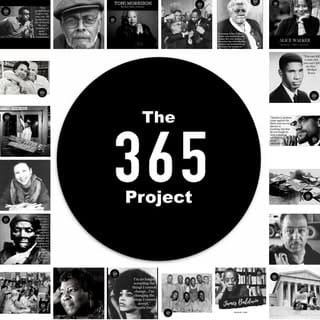
- Following 1.3K
- Followers 12.1K
- Engagement 1.8%
- Avg likes 204
- Avg comments 4
About The 365 Project
The 365 Project (@365daysofblackhistory) is a Non-Profits & Religious Organizations creator on Instagram, also filed under Spirituality & Religion. The account has 12,071 followers and 520 published posts. Recent posts average 204 likes and 4 comments, an engagement rate of 1.8%.
With 12.1K followers, The 365 Project is a micro creator by the common 10,000 to 100,000 definition. The 365 Project follows 1,349 accounts, so the audience is roughly 8.9 times the size of the list followed. The 365 Project is set up as an Instagram business account. Flinque files The 365 Project under Non-Profits & Religious Organizations, with Spirituality & Religion as a secondary category.
The Instagram bio for The 365 Project runs to 17 words across 3 lines. Emoji sit alongside the words. The latest activity Flinque has on record for The 365 Project dates from April 2022.
520 Posts
Of the 10 most recent posts shown for The 365 Project, 8 are single images and 2 are carousels. That mix leans toward single images. The 365 Project has built a substantial archive of 520 posts. Against the audience, that is roughly 23 followers for each post published. All 10 carry captions, averaging 222 words each. The captions are written mainly in English. Words that recur across them include help, black, known, african-american and african. The captions tag #365rewind and #rip.
Born in Indian Territory (today Oklahoma), Rector’s parents were African descendants of slaves of the Muscogee (Creek) Nation. Through the Dawes Act, which divided Creek Nation lands among the Creeks and their former slaves, Rector, and her family all received land. Her 160 acre allotment was valued at $556.50.⠀
⠀
The $30 annual tax fee was more than her father could afford, so he leased her parcel of land to an oil company. The well unexpectedly produced and “gusher” and began to bring in 2,500 barrels of oil a day earning Rector a daily income of $300 at the age of eleven. At the time, the law required black adults and children who were citizens of Indian Territory with significant property and money, to be assigned “well-respected” white guardians. Thus, as Rector’s wealth grew, her guardianship was assigned to a local white resident.⠀
⠀
As her story spread worldwide and negative headlines appeared in newspapers, there were concerns raised regarding the mismanagement of her estate. National African American leaders such as Booker T. Washington and W. E. B. DuBois intervened to help the family. While many of the allegations proved false, this prompted Dubois to establish a Children’s Department of the NAACP, which investigated claims of white guardians suspected of depriving black children of their land and wealth. She soon enrolled in the Children’s School, a boarding school for teenagers at the Tuskegee Institute in Alabama, headed by Washington and upon graduation, she attended the Institute.⠀
⠀
Rector was a millionaire by the time she had turned 18. She owned stocks and bonds, a boarding house, a bakery and restaurant in Muskogee, Oklahoma, as well as 2,000 acres of prime river bottomland. At 18, she left Tuskegee and moved her family to Kansas City, Missouri. The home she purchased there still stands and is known as the Rector Mansion. Unfortunately, like many wealthy Americans, she lost the majority of her wealth during the depression.⠀
⠀
Despite her story drawing international attention at the time, her life is not broadly known today.
Kwanzaa was created by Maulana Karenga (pictured), and was first celebrated in 1966–67. Karenga was a major figure in the Black Power movement of the 1960s and 1970s and co-founded with Hakim Jamal the black nationalism and social change organization US (a complementary yet rival organization of the Black Panther Party).⠀
⠀
Kwanzaa was established as a means to help African Americans reconnect with their African cultural and historical heritage by uniting in meditation and study of African traditions. Karenga said his goal was to "give Blacks an alternative to the existing holiday and give Blacks an opportunity to celebrate themselves and history, rather than simply imitate the practice of the dominant society." Initially, he proposed Kwanzaa as an alternative to Christmas, but changed his stance once it started to gain mainstream attention so as to not alienate Christians. ⠀
⠀
Each of the seven days of Kwanzaa is dedicated to one of the seven core principles (Nguzo Saba).⠀
- Umoja (Unity)⠀
- Kujichagulia (Self-Determination)⠀
- Ujima (Collective Work and Responsibility)⠀
- Ujamaa (Cooperative Economics)⠀
- Nia (Purpose)⠀
- Kuumba (Creativity)⠀
- Imani (Faith)⠀
⠀
If you have any Kwanzaa customs or traditions, please share them below!⠀
⠀
Earlier in 1963, leaders in civil rights groups such as the Southern Christian Leadership Conference (SCLC) were developing plans to use tactics of nonviolent protest to provoke Birmingham leaders to desegregate the city. The demonstrations started in April 1963 and the first phase resulted in many arrests, including that of Dr. Martin Luther King Jr., after a circuit court judge issued an injunction against protests and boycotts. ⠀
⠀
As the campaign continued, SCLC leaders started to plan a “Children’s Crusade” hoping it would help lighten the tensions. There was hesitation to involve the young children in the frontlines of the protests, but their actions proved to be instrumental to the movement. Thousands of children were trained in the tactics of non-violence and in May of 1963, they marched the streets of Birmingham in peaceful protest with the hope to speak to city officials about segregation in the city. Not surprisingly, they were met with resistance. Thousands of arrests were made and on the second day police were ordered to spray the children with powerful water hoses, hit them with batons, and threaten them with police dogs.⠀
⠀
Despite this harsh treatment, children continued to volunteer to participate in the demonstrations over the next few days. Their persistence would gain national attention and pressured local officials to agree to meet with civil rights leaders and discuss plans to end the protests, and on May 10, an agreement was reached. ⠀
⠀
While the struggle for equality in Birmingham would continue, the thousands of children, some as young as 7 or 8 years old, who participated in these demonstrations brought a reignited momentum to the movement in a powerful way.
⠀
The 369th Regiment was formed from the National Guard's 15th Regiment in New York in 1915. Racial prejudice was strong in the military and because many white American soldiers refused to perform combat duty with blacks, in 1918 the unit was assigned to the French Army, with whom they fought for the duration of American participation in the war. ⠀
⠀
Many African Americans believed that entering the armed forces would help eliminate racial discrimination throughout the United States and prove they deserved respect through service in the armed forces. However, after the war, these soldiers were subjected to the same inequalities when they returned home. The regiment’s service did highlight the hypocrisy behind sending African-Americans to fight for democracy abroad, while racial segregation and inequality prevailed at home. These brave men helped pave the way for thousands of brave African-American soldiers who later proudly fought and died for their country.⠀
⠀
Another interesting fact: Not only was the 369th regiment known for their fighting skills, but they had a very talented marching band. In fact, by the end of their tour they had became one of the most famous military bands throughout Europe. James Reese Europe, a renowned ragtime and jazz musician, served as both an infantry officer and the regiment’s bandleader.⠀
⠀
Walker started her career as a teacher at Lancaster School in Richmond, however she had to leave her job when she got married due to the school’s policy against married teachers. She then became more active in the Independent Order of St. Luke, an organization dedicated to the social and financial advancement of African Americans. Walker rose in the ranks quickly and in 1899, when the organization was on the verge of bankruptcy, she was appointed grand secretary. ⠀
⠀
During her tenure, she would completely turn the group around into a profitable and effective organization. She founded the St. Luke Herald newspaper to carry news of the Order to local chapters and to help with its educational work. She also established a youth arm to inspire social consciousness in young African Americans. Moreover, she opened the St. Luke Emporium, a department store that offered African-American women opportunities for work and gave the black community access to cheaper goods.⠀
⠀
In 1903, Walker opened the St. Luke Penny Savings Bank, making her the first women to charter a bank in the US. She believed a bank would combat the oppressive conditions of racial segregation while encouraging economic independence and thrift in the black community. Under Walker's continued leadership, the bank served a membership of more than 50,000 in 1,500 local chapters and issued more than 600 mortgages to black families helping them realize homeownership dream. She even managed to keep the bank thriving during the Great Depression. While St. Luke was not the first bank started by an African-American, it is believed to have been the oldest continuously black-owned bank in the country until it was purchased in 2005.⠀
⠀
Walker was a true pioneer for the black community. She devoted her life to civil rights advancement, economic empowerment, and educational opportunities for African Americans and women.
⠀
Like other black communities founded during this time, Eatonville was a place where freed blacks could live somewhat isolated from the racial divide and violence prevalent in other parts of the country. The town provided the opportunity for self-government, economic development, and education. The first two institutions to be established in the town were a church and school. The Methodist Church, known today as the St. Lawrence African Methodist Episcopal Church, was the first African American church in the area. The school, the Hungerford Normal and Industrial School, was founded in 1889 and by the mid-1930s, had become the premier place for African-American learning in central Florida.⠀
⠀
Eatonville is also the hometown of author Zora Neale Hurston and is featured in her novels “Their Eyes Were Watching God” and “Mules and Men”. Each January, the town holds its annual Zora Festival, a month-long celebration of the arts and humanities in her honor. The festival draws over a hundred thousand visitors to the small town and has featured performances by many musicians, including the Isley Brothers.
Cicely Tyson (1924-2021) - Tony and Emmy award winning television, film and stage actress who is known for taking roles that portray African-American women in a positive image. Growing up in Harlem, at the age of 18, Tyson began modeling and soon after started acting. Her work includes such classics as Sounder (for which she was nominated for an Academy Award), Roots, The Autobiography of Miss Jane Pittman (Emmy Award winning role), and The Help. Throughout her career, Tyson has remained particular about the roles she has taken, staying true to her desire to make purposeful work. After 30-years, Tyson returned Broadway, with a role in Horton Foote's The Trip to Bountiful, for which she won the 2013 Tony Award for best performance by an actress in a leading role in a play.
The 365 Project's engagement
The 365 Project's engagement rate on Instagram is 1.8%, between 1% and 3%, or 1 to 3 likes and comments per 100 followers. On a typical post that comes to about 1 like or comment for every 56 followers. Likes outnumber comments by roughly 51 to 1, with 204 likes and 4 comments on an average post, so most reactions are taps rather than replies.
Engagement rate
1.8%
- Avg likes
- 204
- Avg comments
- 4
- Interactions : followers
- 1 : 56
Lookalike Creators
A free account lists creators whose audiences behave like this one, ready to shortlist and compare side by side.
Age & Gender
Unlocking shows how this audience splits across age bands and gender, charted from follower data.
Audience Location
Unlocking reveals the countries and cities where the most active followers of this account are concentrated.
Primary Language
Unlocking shows the languages this audience uses most in comments, interactions and the content it consumes.
Audience Interests
Unlocking lists the topics and categories this audience follows and engages with most often across the platform.
Authenticity
Unlocking scores how genuine the audience is, flagging fake, inactive or bot followers found in engagement patterns.
Audience Quality Score
Unlocking gives one overall audience quality score combining authenticity, engagement, follower activity and audience relevance.
Brand Affinity
Unlocking names the brands this audience already follows, mentions or engages with across social platforms.
Content Strategy
Unlocking breaks down the content pillars, tone and visual style this creator uses, and which formats perform best.
Commercial Insights
Unlocking shows collaboration types, an estimated pricing tier and a brand safety risk read for sponsored campaigns.
Industry Fit
Unlocking rates how well this creator and audience align with specific industry verticals and brand categories.
Research The 365 Project further
Flinque ranks Instagram creators in Spirituality & Religion, categories The 365 Project is filed under, and its free tools measure the same figures for any public account.
Related rankings
Frequently asked questions
These answers about The 365 Project are generated from the Instagram profile data Flinque holds for the account.
Who is The 365 Project?
The 365 Project (@365daysofblackhistory) is a Non-Profits & Religious Organizations creator on Instagram, also filed under Spirituality & Religion. The 365 Project is set up as an Instagram business account. The Instagram bio for The 365 Project runs to 17 words across 3 lines.
How many followers does The 365 Project have?
The 365 Project has 12,071 followers on Instagram (12.1K). The 365 Project follows 1,349 accounts, so the audience is roughly 8.9 times the size of the list followed. The 365 Project has built a substantial archive of 520 posts.
What is The 365 Project's engagement rate?
The 365 Project's engagement rate on Instagram is 1.8%, between 1% and 3%, or 1 to 3 likes and comments per 100 followers. On a typical post that comes to about 1 like or comment for every 56 followers. Likes outnumber comments by roughly 51 to 1, with 204 likes and 4 comments on an average post, so most reactions are taps rather than replies.
What does The 365 Project post about on Instagram?
Flinque files The 365 Project under Non-Profits & Religious Organizations, with Spirituality & Religion as a secondary category. Of the 10 most recent posts shown for The 365 Project, 8 are single images and 2 are carousels. The 10 recent Instagram captions Flinque holds for The 365 Project repeatedly use the words help, black, known, african-american and african. The 365 Project's captions carry hashtags such as #365rewind and #rip. The 365 Project writes those captions mainly in English.
How do I contact The 365 Project for a collaboration?
The 365 Project's contact details are not published on Flinque's public profile. The Instagram bio links to 1 external site, and a free Flinque account opens that link. The account is registered as an Instagram business account. Brands with a free Flinque account can shortlist The 365 Project and use Flinque's outreach tools wherever a contact route is on file.
Links
The 365 Project's own Instagram profile is the one outbound link Flinque publishes for the account, and the bio link opens after signing up.
Public profile data sourced from Instagram. Flinque is not affiliated with The 365 Project.